Batter Up Baking Sticker Design
First Impressions: Cheerful, Clear, and Kitchen-Ready
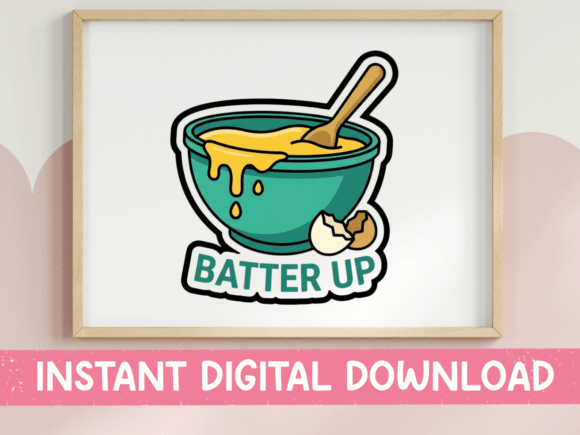
When I opened Batter Up Baking Sticker Design, my first thought wasn’t “cute” — it was “usable.” As someone who’s stitched hundreds of kitchen-themed designs for Etsy sellers, boutique aprons, and custom baby onesies, I immediately saw how this graphic translates to thread. The cheerful teal mixing bowl has strong, clean outlines — ideal for satin stitch definition. The golden yellow batter drips with playful weight, not fussy detail, and the wooden spoon + cracked eggs add just enough narrative without overcrowding. It reads instantly at 3–4 inches wide, which means it’ll hold up beautifully on a tote bag, sweatshirt chest placement, or tea towel corner.
Where It Shines: Real Projects, Real Customers
I recently tested Batter Up Baking Sticker Design on a medium-weight cotton canvas tote for a local bakery’s staff gift set. Stitched at 3.75", it landed exactly right: friendly but not childish, clever but not obscure. Customers smiled — especially bakers who recognized the inside joke in the “cracked eggs” detail. It also worked cleanly on a soft-loop cotton sweatshirt (using tear-away + light cutaway stabilizer), where the fill stitch held the batter’s warmth without puffing or bleeding. On a linen tea towel? Perfect. The design’s open negative space lets the fabric breathe, so stitch density stays balanced — no stiff patches or puckering.
For small shop owners: this is a smart embroidery file for cross-category appeal. Pair it with a simple monogram on a baby bib for a shower gift, or scale it down to 2.25" for an embroidered patch on a denim apron. It’s equally effective as a custom apparel centerpiece or a subtle accent on a pillow cover. Because it leans into humor without sarcasm, it avoids dating quickly — unlike trend-driven food graphics that feel stale by next season.
Where to Pause — Not Every Fabric or Fit Is Equal
That said, Batter Up Baking Sticker Design isn’t foolproof across all substrates. On thin jersey t-shirts? Proceed with caution. The batter drips and spoon handle rely on crisp edge definition — stretchy fabric can blur those lines unless you use proper stabilizer and reduce stitch speed. Same goes for dark fabric: golden yellow thread needs high-contrast backing (think white underlay) to stay vibrant. And while the design looks great digitally in mockups, don’t assume it’ll read clearly at under 2" — the eggshell texture and spoon grain fade fast below that size.
Curved surfaces like caps are doable, but only if you’re comfortable repositioning the hoop mid-stitch to keep the bowl upright. The spoon’s diagonal angle doesn’t auto-adjust well on rounded crowns. Also, avoid layering it over seams or thick pockets — the batter’s downward flow gets visually interrupted, weakening the “overflow” storytelling.
Design Integrity Meets Handmade Perception
What makes Batter Up Baking Sticker Design stand out isn’t just charm — it’s coherence. The balance between the bowl’s solid shape and the fluid batter creates visual rhythm. That matters when buyers hold your finished product. A well-executed version says “thoughtful craft,” not “mass-produced clipart.” I’ve seen similar concepts fail because the batter looked like melted cheese or the spoon vanished into fill stitch noise. Here, the contrast between teal and gold feels intentional, not accidental — and that builds customer trust.
For Etsy sellers and craft fair vendors: this design supports brand consistency. Use it across matching aprons, oven mitts, and recipe cards (as a printed graphic), and it becomes a recognizable motif — not just a one-off digital embroidery file. Buyers remember the teal bowl. They tag friends. They request matching items. That’s commercial longevity.
Practical Designer Notes Before You Stitch
- Always test on scrap fabric first — especially if using textured weaves or blends. Linen, terry cloth, and brushed cotton behave differently under needle tension.
- Check thread color contrast on both light and dark backgrounds. Golden yellow pops on navy or charcoal, but can mute on olive or rust — consider swapping to a warm cream or buttery tan for richer bases.
- Review stitch density in your embroidery software. If the batter area feels overly dense, reduce fill stitch percentage slightly — it maintains shape without risking fabric distortion.
- Confirm hoop size compatibility. This design fits comfortably in a 4x4 hoop, but pushing beyond 4.25" may stretch delicate curves. Don’t force scale without testing.
- Inspect small details: the crack in the egg and spoon grain are subtle — they’ll vanish on low-res machines or with coarse thread. Use 40-weight rayon or polyester for clarity.
- Test black-and-white mockups. If it reads strongly without color, your composition is solid — and your listings will convert better across devices.
- Use appropriate stabilizer: light cutaway for knits, tear-away for stable wovens, and fusible for lightweight linens.
- Verify licensing before selling finished items or bundling as part of a craft business kit. Since it’s listed as a T-Shirt Designs Graphics asset, confirm whether commercial use includes resale of physical goods — many designers restrict digital redistribution but allow embroidered products.
Final Thought: A Reliable Workhorse, Not Just a Gimmick
Batter Up Baking Sticker Design earns its place in my go-to folder because it balances personality with practicality. It’s not trying to be fine art or viral bait — it’s a well-constructed, kitchen-hearted machine embroidery design built for real work: holiday embroidery bundles, personalized gifts for teachers and moms, small shop merchandise with heart, and even nursery decor where foodie whimsy feels fresh and warm. It won’t replace your foundational script fonts or classic monograms — but it absolutely complements them. When your customer unzips that embroidered tote or unfolds that tea towel, they don’t just see batter. They feel invited into a moment of joy, skill, and shared kitchen truth. And that’s the quiet power of a design that’s been reviewed, tested, and trusted — not just uploaded.