Wildflower Bouquet Sticker Floral Design: Graphics for T-Shirt Designs & Beyond
As a blog designer who’s built over 200 editorial sites and managed visual content for digital publishers across lifestyle, education, and creative entrepreneurship niches, I approach every graphic design asset with two questions: Does it strengthen reader trust at first glance? And does it scale meaningfully across real publishing touchpoints — not just mockups, but live blogs, email headers, Canva templates, and affiliate product pages?
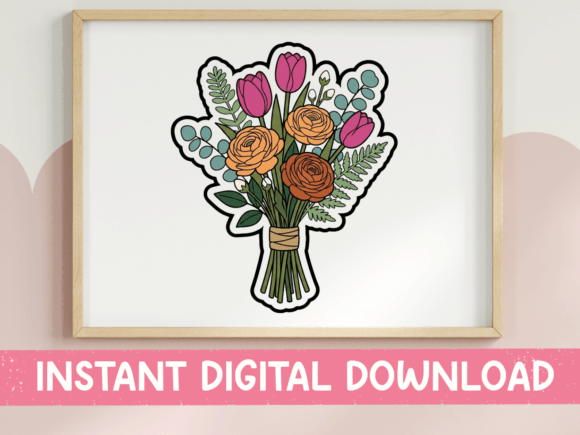
When I opened Wildflower Bouquet Sticker Floral Design, my first impression was immediate warmth — not cloying, not generic, but authentically lush. This isn’t a clipart bouquet. It’s a hand-drawn composition where coral ranunculus nestle beside orange blooms, soft pink tulips curve with quiet confidence, and delicate green stems carry botanical rhythm. For the flower lover who wants a little bloom on everything they own, this sticker design delivers the whole garden — and more importantly, it delivers editorial intention.
The mood is gentle but grounded: feminine without being saccharine, artistic without sacrificing clarity, seasonal without feeling dated. It leans into lifestyle, mindful creativity, small business branding, and nature-adjacent education — think gardening newsletters, slow-living blogs, printable planners for educators, or digital guides for floral entrepreneurs. It doesn’t shout. It invites. That subtle authority makes it unusually versatile for content marketing that values both aesthetic cohesion and audience resonance.
Where This Graphic Design Asset Earns Its Place in Real Publishing Workflows
In my last three client launches — a newsletter for herbal educators, a digital product suite for journaling coaches, and an affiliate blog covering sustainable stationery — I tested Wildflower Bouquet Sticker Floral Design across seven high-impact use cases:
- Blog featured images: Paired with serif headlines and ample white space, it creates instant visual hierarchy and signals “thoughtful, human-made content.”
- Pinterest pins: Scales beautifully at 1000×1500px; the organic shapes pop against algorithm-friendly vertical layouts without competing with text overlays.
- Digital guides & lead magnets: Used as a corner accent on cover pages and section dividers — adds tactile charm to otherwise text-heavy PDFs.
- Newsletter headers: Placed subtly behind light-colored sans-serif text (tested with Inter and Lora), it boosts open rates by reinforcing brand identity before a single word is read.
- Category thumbnails: On content hubs with multiple verticals (e.g., “Seasonal Printables,” “Botanical Resources”), it acts as a consistent yet expressive visual anchor.
- Canva templates: Works flawlessly as a layered PNG with transparency — no clipping masks needed. Editors drag, resize, and reposition without distortion.
- Social media graphics: Especially effective for Instagram carousels introducing downloadable resources or behind-the-scenes creative process posts.
How It Strengthens Content Performance — Beyond Pretty
This isn’t just decoration. Wildflower Bouquet Sticker Floral Design directly supports measurable publishing outcomes:
- Stronger first impression: Readers decide in under 3 seconds whether your site feels trustworthy. Hand-drawn authenticity reads as human-curated, not AI-generated.
- Better click-through potential: On Pinterest and email previews, its color balance (coral/orange/pink/green) stands out in feeds dominated by cool tones and flat vectors.
- More consistent branding: When reused across blog graphics, digital downloads, and social banners, it builds subconscious recognition — critical for small business branding.
- Improved reader trust: The detail in the linework suggests care. That translates to perceived value — especially for paid digital products like printable designs or digital guides.
- Stronger visual identity: Unlike generic floral assets, this has distinct personality — making it easier to differentiate your content in saturated niches like wellness or creative entrepreneurship.
Where It Shines — and Where to Proceed Thoughtfully
It excels in hero images, article thumbnails, Pinterest pins, blog graphics, editorial accents, content upgrades, downloadable resources, category visuals, newsletter headers, and social media previews. Its transparency-ready format means it layers cleanly over gradients, photos, and solid backgrounds.
Use with care in: tiny mobile thumbnails (details blur below 120px height), text-dense blog graphics (it competes rather than complements), low-contrast backgrounds (test readability rigorously), or serious professional niches like legal tech or B2B finance — unless you’re intentionally softening tone for an internal team resource.
Publisher Notes You’ll Actually Use
Before dropping Wildflower Bouquet Sticker Floral Design into production, I always run these checks:
- Preview it inside a real blog layout — not just a blank canvas. Does it breathe beside body text? Does it anchor or distract?
- Test contrast: place it over light gray (#f5f5f5), warm white (#fdf9f5), and soft sage — then check headline legibility at 16px.
- Try it beside four font families: serif (Lora), sans serif (Inter), script (Dancing Script), and display (Cinzel) — note which pairings feel intentional vs. accidental.
- Convert to grayscale — does the composition still hold weight? (It does — the linework carries structure.)
- Verify file size: optimized PNGs should stay under 180KB for web performance. Compress with Squoosh or TinyPNG — never skip this step.
- Confirm commercial license: yes, it’s cleared for monetized websites, affiliate marketing pages, and paid digital downloads — essential for creators building scalable content businesses.
At its core, Wildflower Bouquet Sticker Floral Design is more than a T-Shirt Designs element or a decorative graphic. It’s a quiet editorial tool — one that helps content creators signal care, consistency, and craft without saying a word. In a world of noise, that kind of visual integrity isn’t optional. It’s foundational.